
Chris Mercerhill

-
Chris Mercerhill was born in Toronto, Ontario and has lived in Columbus, Ohio since 2006. His curiosity and diverse interests have led him to study art, art history, French, education, and linguistics, all of which influence his creative practice.
The visual works Mercerhill produces are a physical manifestation of the digital and organic algorithms he creates. These systems define and articulate the rules and patterns in each piece.
His unique creative process involves both adherence and defiance of these rules. “I find repetition to be soothing and satisfying, but I also look to subvert the pattern, breaking it down. Introducing a bit of chaos into the system makes it more interesting.” He often welcomes natural limitations to his process, by using only the indigo that he grows himself, or only the black walnuts that fall into his backyard. Other times, he asks his computer to randomly determine how many shapes or what colors to use. There is a constant tension between defining the regularity of a pattern and subsequently breaking it down that drives Mercerhill’s work.
-
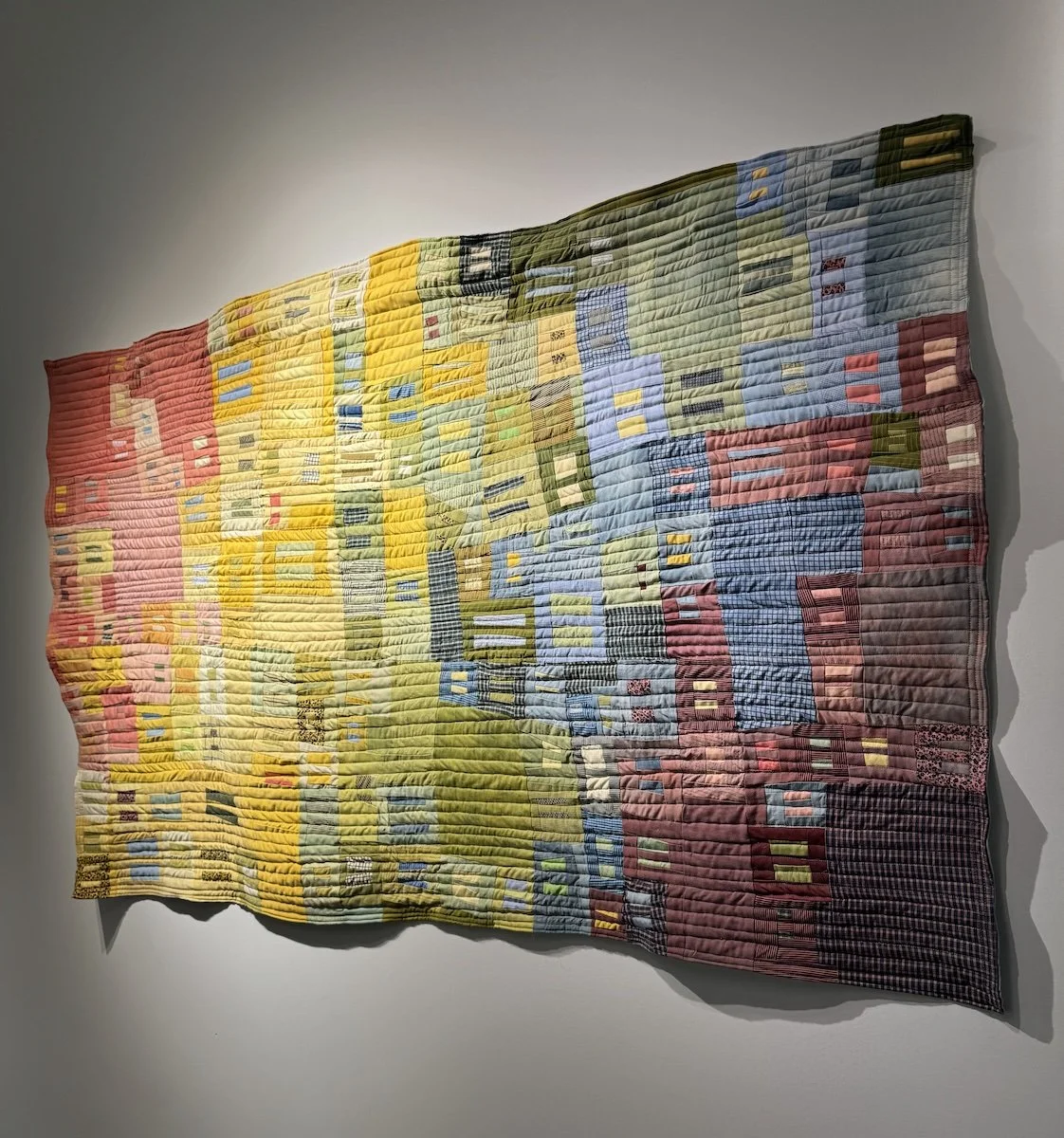
by Chris Mercerhill
36" x 64"
Upcycled cotton
Dyed with indigo, turmeric, madder
This quilt is a true exploration of the spectrum of colors I can acquire and produce. I began collecting all of the brightest colors that caught my eye at local thrift stores. If I found an interesting shirt, I would buy it, take it home, and cut it up. I only work with cotton because it is more environmentally friendly and because it takes dye better than synthetic fabric. To extend my palette, I took upcycled fabric and dyed some of it. Indigo makes everything bluer, turmeric adds bright yellow, and madder is a salmony red. Sometimes, I would dye a pale blue fabric with turmeric to get bright green. Other times, I would overdye a light green with indigo and get teal. If you look closely in this quilt, you can find two or even three different dye combinations on the same fabric.
When thinking about a motif to use with this fabric, I landed on this equals sign. In seeking out the widest breadth of colors for the palette, the desire to emphasize that they are unified and not in competition became important. Some blocks are taller or shorter, wider or thinner, bright and brash or calm and cool. It’s a cliché that rings true: together, we all make up a big beautiful quilt.

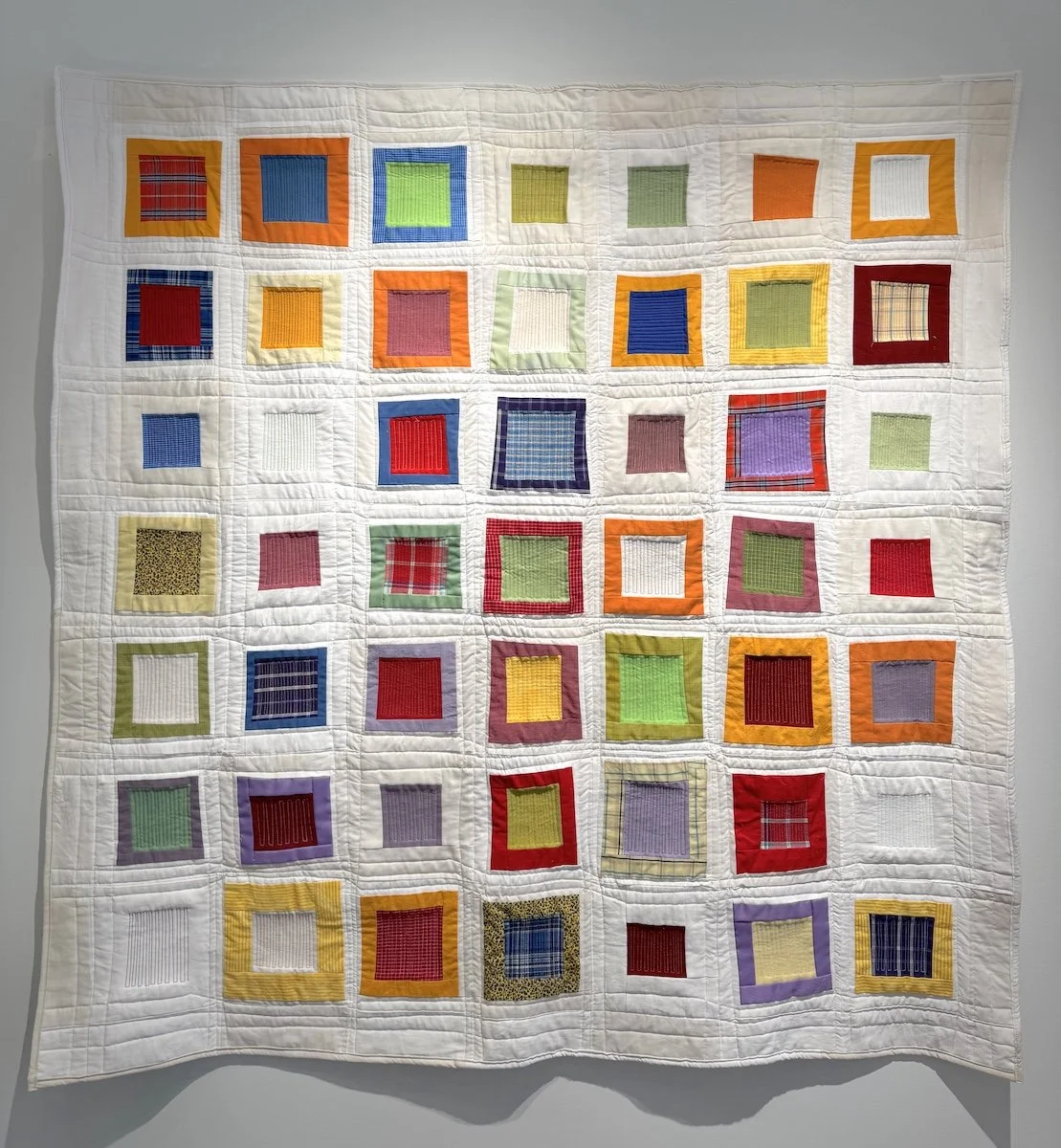
by Chris Mercerhill
66" x 51"
Upcycled cotton
Dyed with black walnuts and madder
The husks of black walnuts yield an intense, chocolatey brown dye. This dye reacts with iron oxide (rust) to become black. But over time, and as it is used, the chocolatey brown dye becomes grey. And black walnut husks that are allowed to dry out yield a softer, sandy / camel brown colored dye. As I worked through these combinations of outcomes, leaving swaths of upcycled cotton to soak and absorb whatever color they would, I was rewarded with this beautiful palette. I’m normally drawn to bright rainbow colors, so this was a departure for me.
As I thought about how I would use these large, sandy swatches, their size led me to envision this composition. It’s like an oasis in a desert. But not a lush, verdant one. More like an industrial one, with its angles and furnaces. I thought of the desert planets in Star Wars with their space hubs where droids slap together junkyard parts to get your ship up and running again. I thought of Mad Max racing through the desert in search of fire and fuel. I thought of Mike Mulligan and his steam shovel clawing at the earth and chewing through hot coal. The title comes from the vision of the gnashing teeth of a glowing, growling furnace.
The composition is a study of contrasts. Large, open, sandy fields and tight, intricate, squares; Earthy browns and bright reds, oranges, and purples; Straight, wide parallel lines of quilting and fussy, detailed, flattening grids; Nature and industry; Dirt vs. grime.
by Chris Mercerhill
55" x 50"
Upcycled cotton
Dyed with indigo and black walnuts
The cotton fabric in this quilt was thrifted locally and dyed with dyes I made from sources that I grew (indigo) or foraged (black walnuts) locally. I could make this same quilt again this year and it would be completely different — different shirts would have been donated to the shop, a different season could make the dyes stronger or weaker. This suburban terroir influences the end product. It is a product of its time and place.
The design is based on a network or lattice that expands outward. Cells are enclosed and break open, connections dissolve, paths are erased, space opens and expands. Each unit is a small bluish rectangle, some of which have one or more dark brown lines attached. As they are assembled, there are questions of which pair should go together, which pairs make a group, what should be added or taken away. This constant series of decisions and choices is unique to improv quilting. Sometimes I find it hard to make decisions, but this process helps to break down inhibitions. Each decision becomes less precious due to the volume of decisions that must be made; I enter more of a flow state where I can just do instead of being weighed down by indecision. The effect is almost one of processing the decisions the way that a computer might.
Title is from “Autobiography” by Sloan
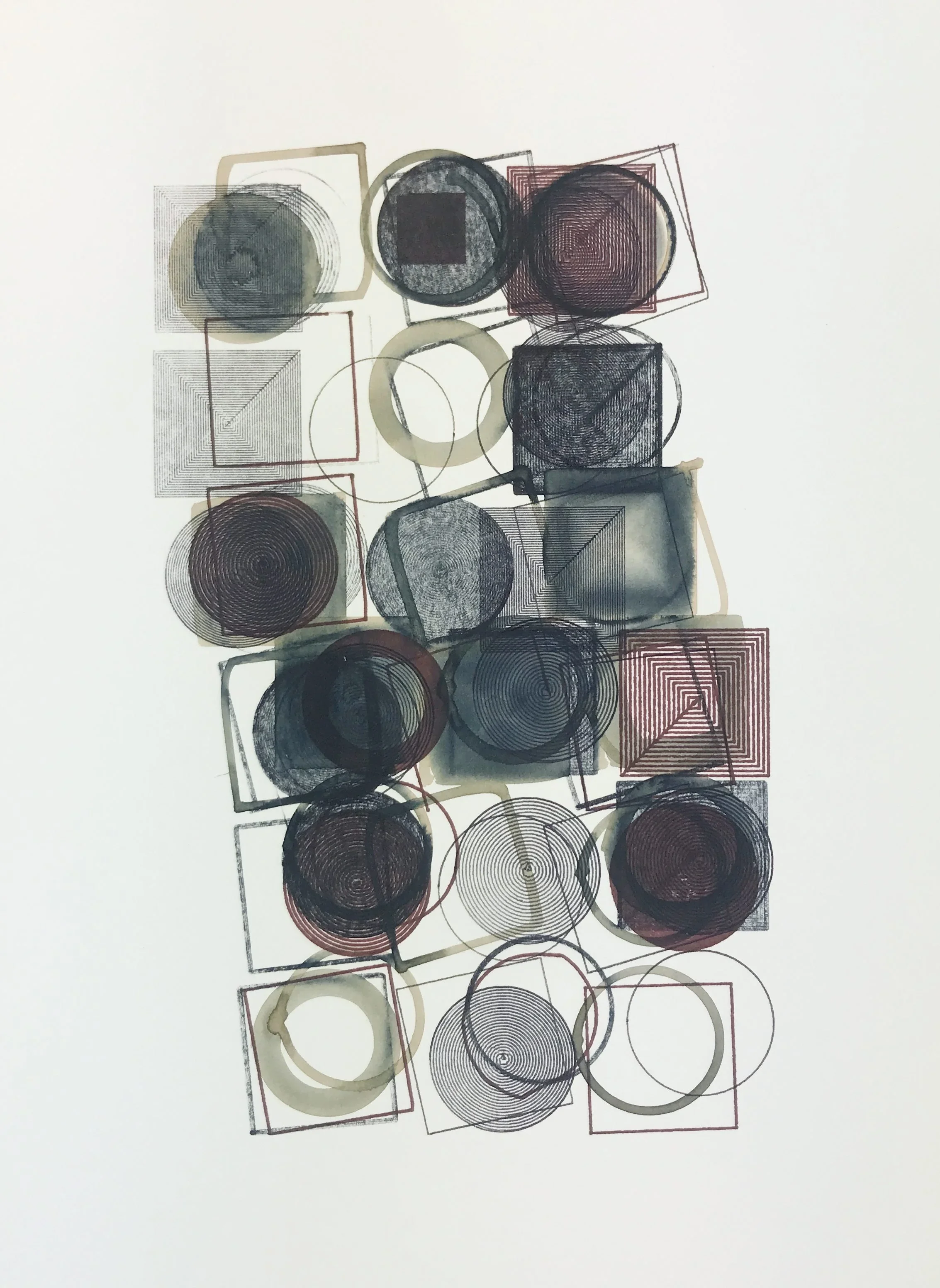
by Chris Mercerhill
9×12 in
Generative drawing using hand-made ink from foraged materials

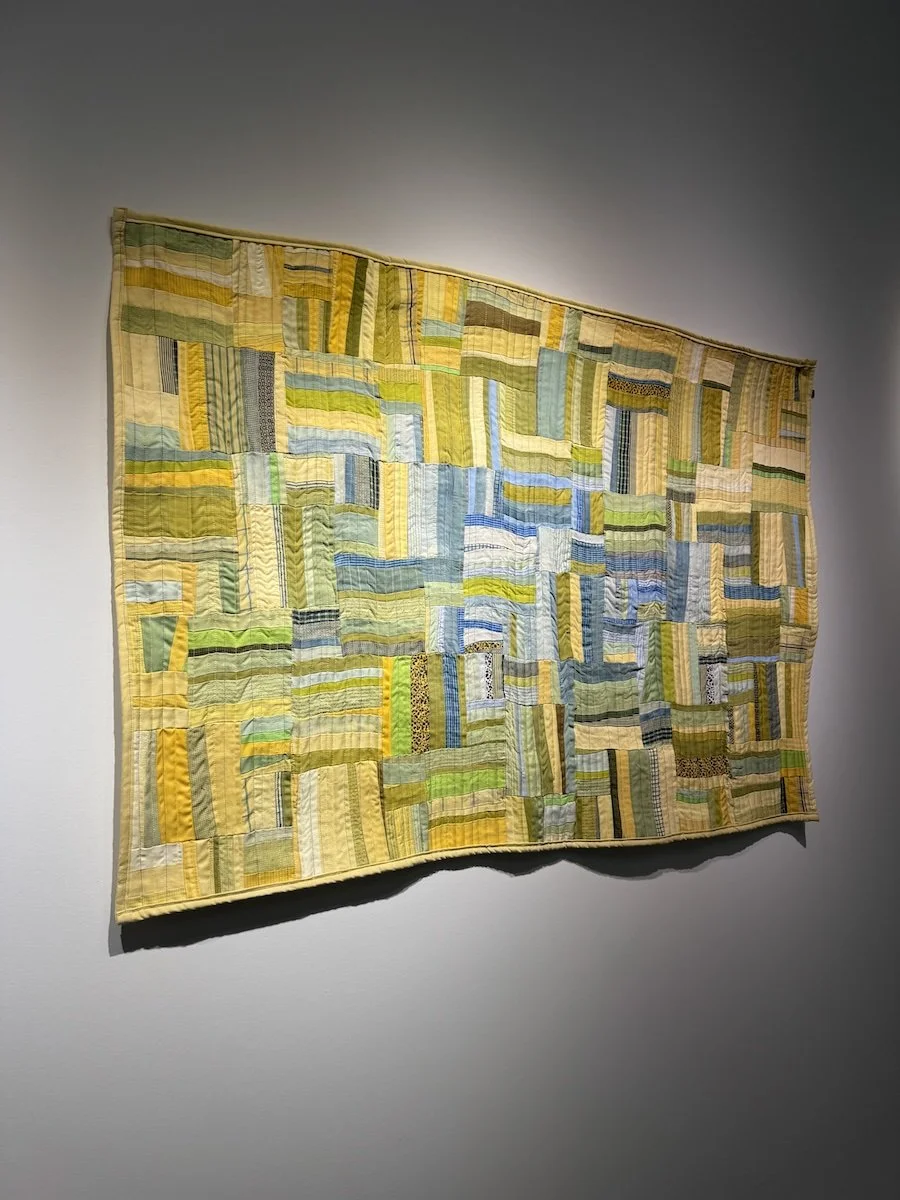
by Chris Mercerhill
30" x 45"
Upcycled cotton
Dyed with indigo and turmeric
In this quilt, there is a tension between freedom, randomness, and chaos versus the structure and stability of a grid. Strips of cotton were torn into strips of varying widths and sewn together somewhat randomly. But these joyful little slashes and strokes have been cut neatly into regular squares. The finished effect is of rolling amber fields under a bright blue sky, but each part is avoiding and courting collisions. Is bad weather rolling in? Would it still be this bright if it were? The title is taken from the Tragically Hip song “Titanic Terrarium.”

by Chris Mercerhill
36" x 54"
Upcycled cotton
Dyed with indigo, turmeric, madder
In addition to collecting bright colored fabrics, I also began to collect black fabrics. The range in this palette is remarkably deep and beautiful. Here, again, the equality motif is used in a wide variety of ways. As a white, cisgendered, heterosexual male, I try to be an ally who stands up for, and alongside with, everyone in my community. At the same time, it’s important to recognize when it is my time to start a conversation versus when it is time to step back and support the people who need to be heard. In the wake of the murder of George Floyd and so many other innocent Black people, I made this quilt as a way of saying to my Black friends and family: I see you, I support you, and I love you.
The title is from the Bruce Cockburn song “Lovers in a Dangerous Time.”

by Chris Mercerhill
68"L x 63"W
Upcycled cotton
Dyed with black walnuts
This quilt is made from black and white (and off-black and off-white) upcycled and thrifted fabric, some of which I have dyed with black walnuts that I foraged. The design is inspired by a drawing by an artist named Bustavo, whom I know from Instagram. The plotter drawing looked to me like columns of chunky black magic marker lines and boxes.
I was inspired to analyze the algorithm that was used to create it and then to create my own with parameters based on my own body: the width of the black columns is the width of my hand, the width of the white strips is two of my fingers, the top and bottom of the strips is the arc my arm creates when I reach up and reach down. The abstract algorithm has been interpreted through my own biological being.
After I created this quilt, I wrote code to create a series of drawings called “After After Bustavo,” which are based on the parameters of this quilt. My computer randomly chooses different block shapes, and draws them at random heights within the top and bottom arcs, which are defined algorithmically. Layers and layers of different iterations of these drawings create the final drawings.

by Chris Mercerhill
55" x 50"
Upcycled cotton
Dyed with indigo and black walnuts
The cotton fabric in this quilt was thrifted locally and dyed with dyes I made from sources that I grew (indigo) or foraged (black walnuts) locally. I could make this same quilt again this year and it would be completely different — different shirts would have been donated to the shop, a different season could make the dyes stronger or weaker. This suburban terroir influences the end product. It is a product of its time and place.
The design is based on a network or lattice that expands outward. Cells are enclosed and break open, connections dissolve, paths are erased, space opens and expands. Each unit is a small bluish rectangle, some of which have one or more dark brown lines attached. As they are assembled, there are questions of which pair should go together, which pairs make a group, what should be added or taken away. This constant series of decisions and choices is unique to improv quilting. Sometimes I find it hard to make decisions, but this process helps to break down inhibitions. Each decision becomes less precious due to the volume of decisions that must be made; I enter more of a flow state where I can just do instead of being weighed down by indecision. The effect is almost one of processing the decisions the way that a computer might.
Title is from “Autobiography” by Sloan
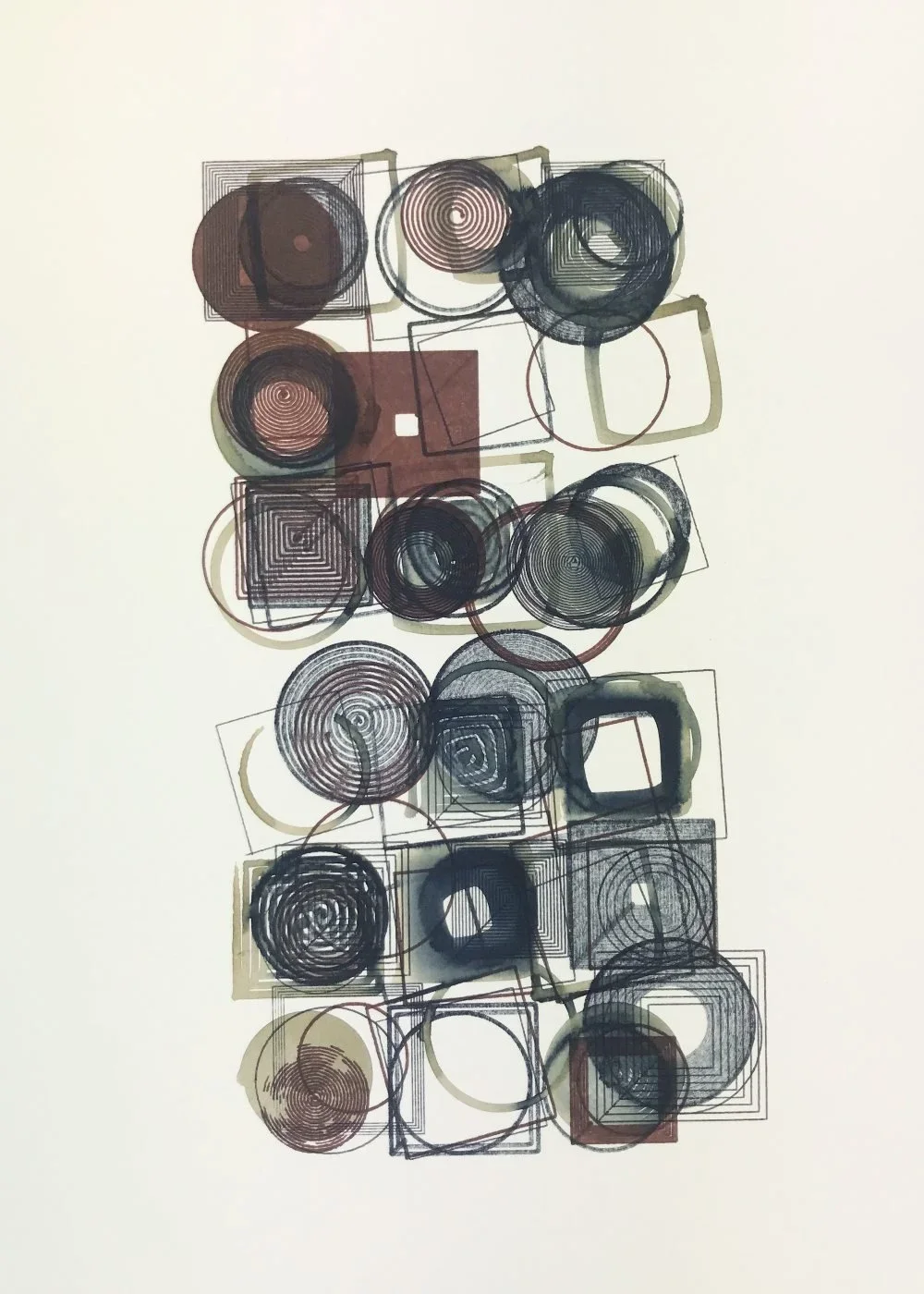
by Chris Mercerhill
9×12 in
Generative drawing using hand-made ink from foraged materials